All about Hawaiian pothos
Hawaiian pothos:
Hawaiian pothos is green and golden pothos that is similar in many respects to giant and golden pothos varieties. It is an ideal plant with beautiful golden color as well as being very easy to care for, fast-growing, and drought tolerant.
If you’re comparing Hawaiian Pothos vs. Golden Pothos as potential contenders for your next indoor houseplant, you’re not alone! Both of these plants are popular with amateur and expert gardeners alike. In this article, horticulturist Madison Moulton compares the two plants by examining their differences and similarities.
With attractive yellow and green foliage, Hawaiian pothos is a rare pothos plant that could easily become one of your favorite houseplants. Since this is rare, though, you can be sure that these plants require a lot of special care.
Fortunately, you’d be wrong because Hawaiian pothos couldn’t be easier to care for, and even novice gardeners can grow these plants into lush, beautiful houseplants.
Air pothos produces oxygen at night, so you and your family can breathe easier. They will absorb some of the harmful chemicals in your home and leave the air clean and fresh. Hawaiian pothos will also bring beauty and a peaceful atmosphere to your home, and are the perfect accent to any style of decor.
This is why it is important to consider these two types of plants when growing them together.
A significant difference between golden pothos and Hawaiian pothos is the color of the foliage and stems. Golden Pothos, on the other hand, has a much more pronounced and intense yellow color. Hawaiian pothos, on the other hand, is a variegated plant with dark green, yellow, and white streaks. While golden pothos prefers low light, Hawaiian pothos prefers medium to bright light.
Hawaiian Pothos is a wonderful foliage plant that is a great addition to any indoor garden.
These large, dramatically patterned leaves will add a tropical feel to any space, and are one of the easiest houseplants, even for beginners.
Grow giant Hawaiian pothos year-round outdoors or indoors in warm climates.
Pothos is usually one of the easiest houseplants to grow! If you are someone who is often away from home or forgets to water your plants, then you should grow Pothos!
If you need help watering your plants, try this automatic drip irrigation kit.
This type of plant is native to the Solomon Islands. Its leaves are heart-shaped and often have white, pale green, or yellow stripes.
Golden Pothos vs Hawaiian Pothos (Differences and Similarities)
As mentioned, there are some important differences and several essential similarities between these two plants.
Let’s start with how to tell them apart, then move on to why it’s fun to own both.
Differences
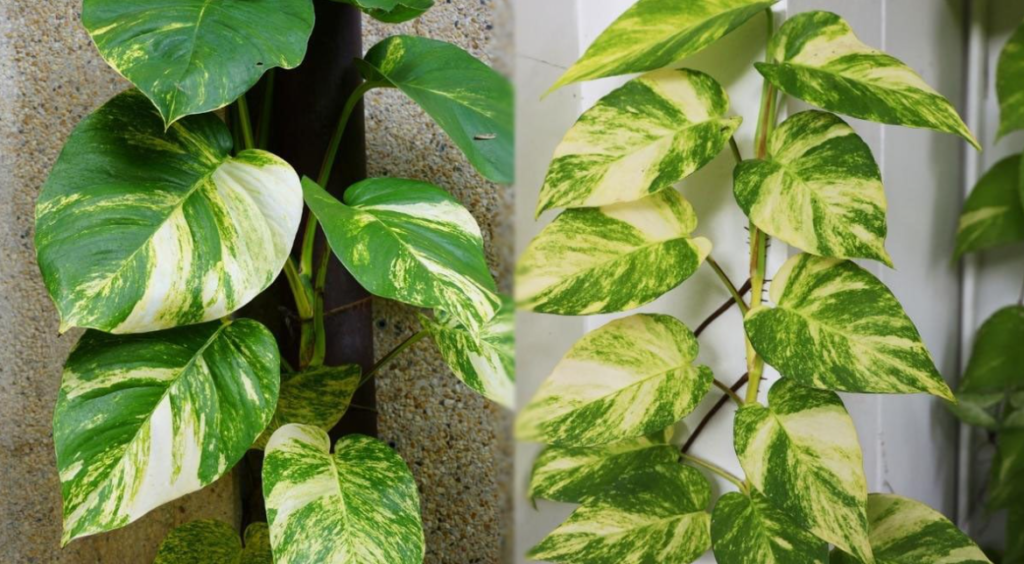
There are 4 key differences between golden pothos and Hawaiian pothos (not counting their names).
These 4 differences (in order of how easy they are to spot) are as follows:
Stem color
A common misconception is that vines have vines and multiple stems.
In fact, the stem is the vine, and the small stem-like structures attached to the leaves are called petioles.
Hawaiian pothos has beautiful green stems and petioles that can be quite attractive on their own.
In contrast, golden pothos has spring green to yellow vines and petioles. In some cases, the latter may also produce minor variations.
Remember that the stem and petiole colors we mentioned are for healthy plants where all the conditions (such as they are minor) are being met.
When plants are diseased or not receiving adequate light, the stems and petioles may discolor, darken, or become a sickly shade of yellow.
Fenestrations
The word fenestration is a fun one. The term means “window” and is used to describe only two phenomena:
Defense (the act of throwing someone out of a window)
Vegetative fences (natural holes in leaves that act like little windows)
Golden Pothos is a cultivar that sometimes produces fenestration. As the leaves age, the inner surface may crack, forming natural windows.
These shrubs are believed to allow light and water to pass through the otherwise dense vegetation.
Lighting requirements
Medium indirect sunlight is ideal for variegated aerial pothos, but they do well in some low-light conditions. In low-light areas, they may lose their contrast over time. What I do with my different colored pothos plants is to move them around, I have a couple in my bathroom with low light and a couple in my bedroom that get a lot of light and show their variations. bring I rotate them when watering, so the low light moves to the bright areas once in a while and vice versa.
There are so many wonderful varieties of pothos that it can be difficult to maintain. From white spots to gold flakes, there’s an option for every type of houseplant lover. But when you start comparing the different varieties available to grow as your next houseplant, the choice can get a little confusing!
The golden pothos, the most common of all pothos species, looks almost identical to another interesting cultivar – the Hawaiian pothos. There is very little that separates the two, with only minor differences in appearance allowing you to identify which is which.
In this guide, you’ll learn everything you need to know about both plants. That way, there’s a little background on everyone before you’re welcomed into your home. Or, you can do what I often do, which is grow one of each, even in the same pot! Let’s jump in and take a closer look at these two popular houseplants!
What does Hawaiian pothos look like?
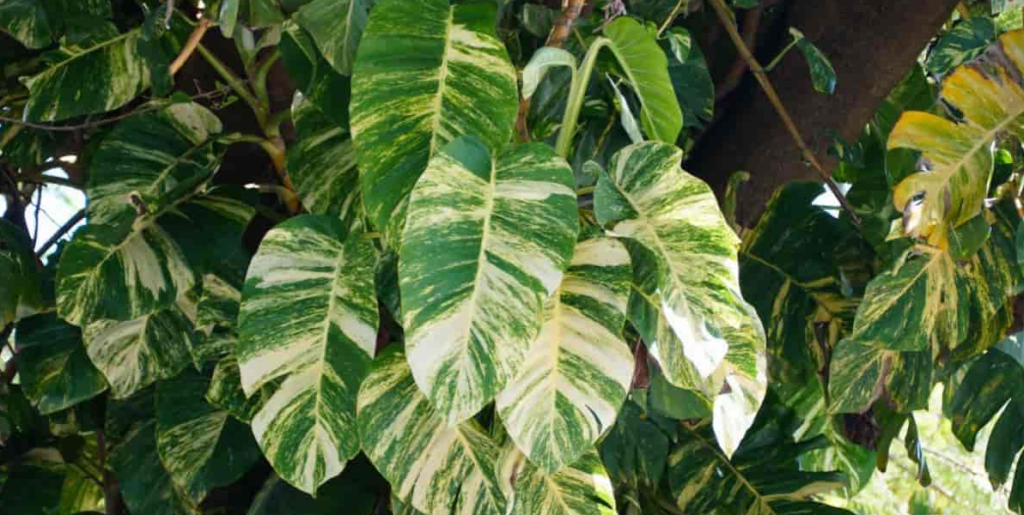
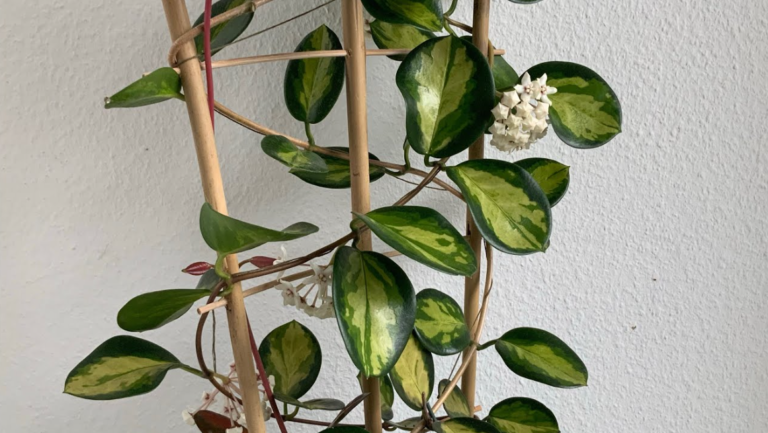
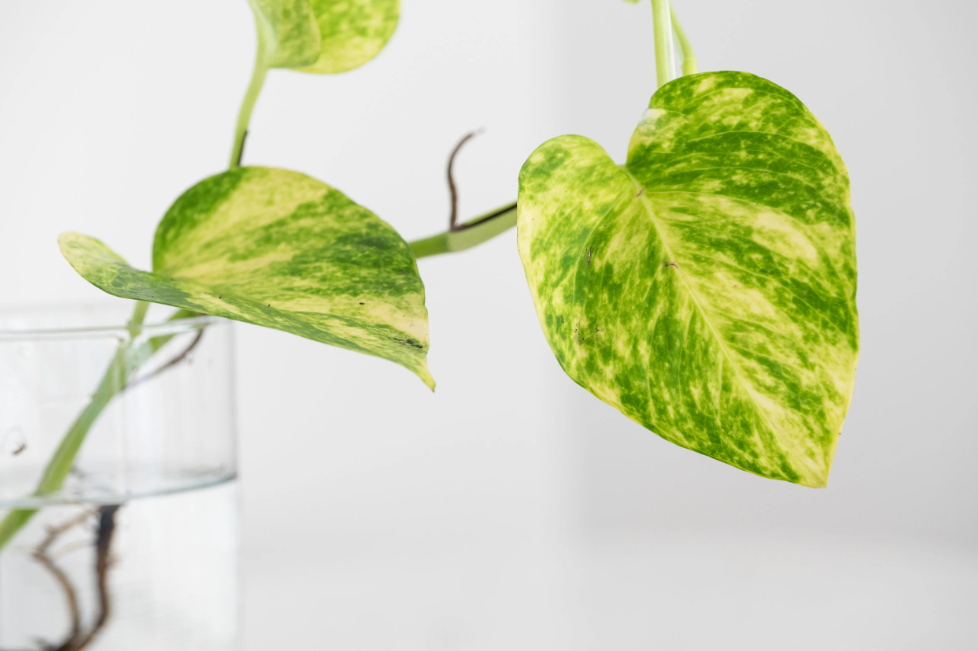
Hawaiian pothos is a beautiful plant with bright multi-colored leaves. These leaves are unusual because they have bands of green and gold. When the plant is healthy, the leaves can be very large, and the leaves can reach a size of 5 to 12 inches long.
You can see an example in the image above, which should give you a pretty good idea of why these different types of pothos are so valuable in people’s homes.
Classification
Walls of green leaves.
These two plants look very similar because they are part of the same species.
All pothos plants come under Epipremnum aureum. Their primary common name comes from the original genus in which they were placed when they were first classified.
But, they are also commonly called devil’s ivy because of their ability to spread and take over an area, as well as mini plants, bringing luck and financial prosperity to some regions.
Golden Pothos is the common name of the main species. It is named after the golden pothos specific epithet aureum which refers to the golden bush in the leaves. Golden Pothos is common worldwide, and one of the most recommended beginner-friendly houseplants.
How often do water
Check them once a week and water if the top 50% or more of the soil is dry.
Hawaiian Pothos Fertilizer
Use a balanced diet of plants every month during the spring and summer months.
soil
A well-draining potting compost. Add some perlite for drainage.
Tip: Take cuttings from leggy stems and put them back together with the main plant to create a bush.
When to Repot
They grow quickly so you may need to report regularly. When they are attached to the roots, keep them in one size. You can take cuttings a month or so earlier and pot them up to make it bushier.
Hawaiian Pothos vs Golden Pothos – Similarities
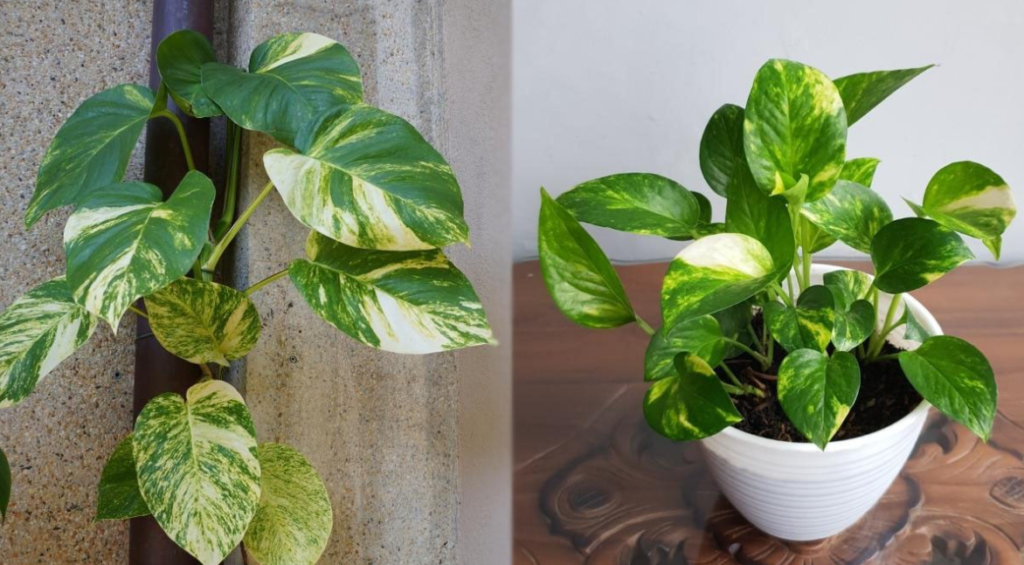
Let’s take a look at some of the similarities between Hawaiian Pothos vs. Golden Pothos below:
- A Pothos Both Hawaiian Pothos and Golden Pothos have similar leaves.
- Both Hawaiian pothos and golden pothos are heart-shaped with pointed tips. Both plants need a lot of sunlight to grow and bloom well.
- They also need plenty of space to grow and develop a strong root system.
- In size and shape, these two plants are similar, and both are climbing plants like grapes.
- in size and shape, these two plants are similar, and both are climbing plants like grapes.
- Both Hawaiian pothos and golden pothos grow mostly upwards and do not grow in width.
- Both Hawaiian Pothos and Golden Pothos require similar light requirements.
- They don’t need a lot of direct sunlight but shade sunlight.
- Both these plants require a lot of water and have similar water requirements.
- Water them often but don’t let the plant sit in water for too long.
- Both types of pothos prefer warmer temperatures and can thrive between 65 and 85 degrees Fahrenheit.
- They also like to live in humid conditions.
Note that you won’t always see fenestrations appear on golden ponies, but when they do, they start a conversation.
Hawaiian pothos plants are not known to be bushy, making this a rare but distinct difference between the two plants.
Variations
Depending on the age of your pothos plant and whether it is getting adequate light, this is a difference you may or may not notice easily.
Both plants have a variety of streaks that roughly follow the veins but can be either spotted or long and thick.
Variations can also vary from one leaf to another, making each leaf unique.
Hawaiian pothos has dark green leaves with white and yellow stripes.
In contrast, golden pothos gets its name because the streaks are more vibrant, with some white but mostly bright yellow to spring green that often threatens to take over the leaf. Make
Lighting
This difference is probably the only reason you might need to be able to tell these two types apart.
Both plants require bright, indirect light and can be damaged by direct sunlight (except for a little morning exposure).
However, the variation in Hawaiian Pothos is more subtle. It requires only slightly longer or more intense periods of sunlight than golden pothos to maintain variegation.
Golden pothos produces yellow vines.
If given enough light, all goldens will develop yellow vines. This photo is right next to a mounting panel. Some of my vines are even variegated.
On the other hand, Hawaiian pothos usually develops green stems when all growing conditions are met. If you are still not sure about the difference between golden and Hawaiian pothos, take a look at the picture below.
Golden Pothos is the common name of the main species. It is named after the golden pothos specific epithet aureum which refers to the golden bush in the leaves. Golden Pothos is common worldwide, and one of the most recommended beginner-friendly houseplants.
Hawaiian pothos is a variety of the same species. This means that these two plants are incredibly closely related, with only a few minor characteristics that separate them.
Both plants belong to the Epipremnum genus along with other tropical plants such as Epipremnum pinnatum. The genus is part of the arum family – Araceae – which includes the closely related, Philodendron.
Philodendron hydraceum is often confused for pothos plants due to their similar structure and appearance. However, both plants have unique coloration that does not appear in any of the Philodendron hederaceum cultivars, making it easy to tell them apart.
How do you care for Hawaiian pothos?

Hawaiian pothos is very easy to care for, and in fact, they are one of the easiest houseplants to care for. They only need to be watered when the soil is dry. Hawaiian pothos only need moderate light and as long as they have 3 or 4 hours of filtered sunlight per day, they will do just fine.
The beauty of pothos comes not only from its appearance but also from its ease of maintenance. With some pretty basic care, your Hawaiian pothos will thrive, making it much less fussy than other houseplants.
Homeland
Big trees with devils and ivy growing on them
Pothos plants, when left in their natural tropical habitat, can grow to about 10 feet.
All Pothos species are native to the islands of French Polynesia. They live in tropical forests where the climate is hot and humid. This explains their love of indoor conditions and higher heat tolerance than other houseplants.
All Pothos species are classified as invasive in some regions. Released from their habitats into new areas, vines spread rapidly, suffocating native vegetation and taking over entire regions.
If you grow any of these plants, it’s important to keep them in your containers and indoors to avoid destroying native habitats.
When planted outside and in the right climate, you may not be able to identify any of the plants. These plants grow very tall outside – well over 10 feet – and grow massive leaves with split sides.
Already large aerial pothos grows larger than a foot in width alone with even larger leaves outside.
How Often Do You Water Hawaiian Pothos?
Hawaiian pothos does not need much water. Most pothos plant owners water their plants only when the first inch of soil in the pot is dry. Generally, it works out that a Hawaiian Pothos only needs to be watered every 7 to 10 days.
One thing that is great about this plant is that you don’t have to think about how often to water your pothos because the plant itself will tell you when it gets too dry. If you notice that your pothos has droopy leaves, this is the plant’s way of saying it needs water.
Water by placing the plant in a sink and pouring water over the plant until the water runs out of the holes in the bottom of the pot. Let the plant sit in the sink for four or five minutes to stop dripping. Then, return the Hawaiian Pothos to their regular place.
When you water your Hawaiian pothos, you should use room temperature water to avoid shocking the plant with too hot or too cold water. Do not use soft water to water your pothos plants because it contains salts that accumulate in the soil and can damage the plant over time.
Common House Plants Close Up
Both plants are fairly easy to find, depending on where you look.
Golden pothos, the original pothos, is not a rare plant. They are quite common and are often purchased as excellent starter plants for new indoor gardeners.
You can find them at any local nursery or garden supply store. They are also available for purchase online, often in hanging pots but also often around moss poles.
Hawaiian pothos can be a little harder to find, but they are not considered incredibly rare. Where you may struggle is finding one that is labeled correctly.
Both plants look incredibly similar in their early stages of growth. Golden pothos in nurseries may be named Hawaiian pothos if the leaves are the same size and vice versa.
It is therefore important to buy from a reputable seller to ensure that you are getting the exact plant you are looking for.
Appearance
When comparing the appearance of these two plants, the color usually stands out first. But there are also some subtle differences in the shape of their leaves. They also differ slightly in size, so let’s take a closer look at all of these factors.
Should I Recall My Hawaiian Pothos?
Hawaiian pothos plants are tropical plants and grow wild in humid

climates. For this reason, the dry air in your home can be harsh on your pothos plants. From time to time, you’ll want to give your pothos plant a light wash to help keep it healthy.
You don’t need to mist your plant, but a light mist once or twice a week, especially during the winter months when the indoor air is very dry, can help keep the plant healthy. Yes, given how humid your pothos like it. Do not soak the leaves or allow them to drip, but instead, only a light spray is needed.
If you mist the plants too much, leaving them wet all the time, your Hawaiian Pothos plant can develop fungal diseases. As with most things in life, moderation is key when it comes to forgetting your Hawaiian Pothos.
Leaf shape
Heart-shaped plants
Both plants have heart-shaped leaves, but golden pothos leaves are slightly more pointed.
The leaves of most pothos plants are classified as heart-shaped, with rounded bases and pointed tips. The leaves are slightly drawn where the petiole meets the leaf, creating a soft heart shape. This pattern is more pronounced in some cultivars than others.
The leaf shapes of both plants are very similar. The only distinguishing factor is that Hawaiian Pothos leaves are slightly rounded at the tips compared to Golden Pothos, but this can also vary from plant to plant.
Ultimately, based on appearance alone, it is difficult to tell these two plants apart.
How Much Light Do Hawaiian Pothos Need?
These plants are excellent houseplants because the light requirements of Hawaiian Pothos are very low. As long as you give them three or four hours of filtered sunlight a day, your Hawaiian pothos plant will thrive. These are great plants for homes that don’t have tons of natural light and windows.
To keep your Hawaiian Pothos plant healthy, you should place it in an east-facing window. If you don’t have an east-facing window, however, meeting your pothos’ lighting needs will be fine either way. If you place your plants in an open, south-facing window, you may want to cover the window with curtains or some blinds to protect them from sunburn.
Although some houseplants can be moved outside during the warmer months, you may want to think carefully before placing your Hawaiian pothos outside. This type of pothos needs deep shade, so if your porch can’t provide it, your plant may suffer. They can get sunburned or overheated quickly, so be careful before taking them outside.
Color of leaves
A variety of flax plants
Both plants are quite similar in color.
The golden pothos has golden-colored veins that give it its name. The pattern varies from leaf to leaf, with some having green spots and gold spots, while others are almost glowing with varying amounts of yellow.
Hawaiian Pothos has a similar pattern and color. At first glance, they look like the same plant. However, upon closer inspection, you may notice that the color of Hawaiian pothos is pale yellow, almost creamy in color, and may even be white.
With higher light levels, Hawaiian pothos can be a deeper, more golden yellow. But the variation will usually be milder and less severe than that of golden pothos.
How do you prune Hawaiian pothos?
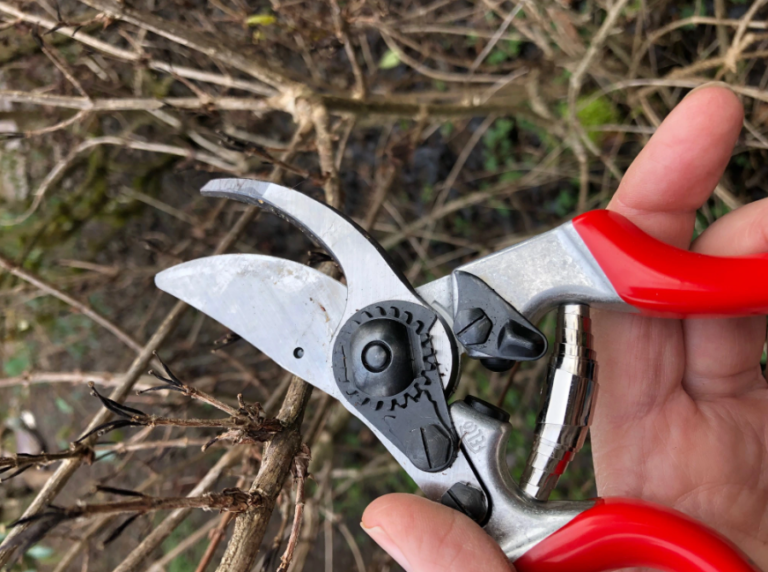
From time to time your Hawaiian Pothos plant will begin to grow back into place. When this happens, you may want to consider pruning the plant without damaging it. To prune Hawaiian pothos, you will take a pair of sharp scissors or shears and cut the vines from the back.
Over time, a Hawaiian pothos plant will grow too large or its stems will become excessively woody. When this happens, pruning will rejuvenate the plant, allowing for healthy growth. This should be in spring or early fall.
When you prune your Hawaiian pothos, don’t cut the plant back more than one-third. It still needs enough leaves to make food for itself. Cutting it too hard can shock or kill the plant.
If your plant is diseased or infested with pests, you may not want to prune it until these problems are under control. Harvesting at these times can spread disease or pests. Fix the problems first, and then you can prune your Hawaiian Pothos plant.
Size of the plant
Two similar plants
Hawaiian pothos is often the larger of the two.
Plant size is the only way to tell these two plants apart, and even that isn’t definitive in every case.
The main difference between these two pothos plants is the size of the leaves. Golden pothos is relatively small indoors, while Hawaiian pothos leaves are very large under the same conditions – usually larger than the size of your hand if the lighting is right.
Hawaiian pothos plants are generally large and grow relatively quickly due to their size and large leaves that receive more sunlight. But this growth gap is usually so small as to be almost negligible.
Instead, pay attention to the size of the mature plant’s leaves and you should be able to tell the two plants apart.
What to do if my Hawaiian Pothos has yellow leaves?
Yellow leaves are a sign that all is not well with your Hawaiian pothos. The plant may need an adjustment to sunlight levels, less watering, or some fertilizer. These are easy fixes if you catch the problem early, so if you see yellow leaves, now is the time to act.
The most common cause of yellow leaves on a pothos plant is overwatering. This will cause the roots to become wet and prone to rotting. Make sure you let the soil dry out the first inch before watering the plant and empty any puddles of water after watering.
Pothos plants that receive insufficient sunlight begin to turn yellow. Pothos plants are low light plants, but they are not light plants. If your plant sports yellow leaves and is kept in a dim environment, move it to a sunny location.
Finally, yellow leaves on your pothos plant may mean it needs to be fertilized. If you fertilize your pothos regularly, it may need new soil as some fertilizers can cause salts to build up in the soil. Repot the plant with new soil.
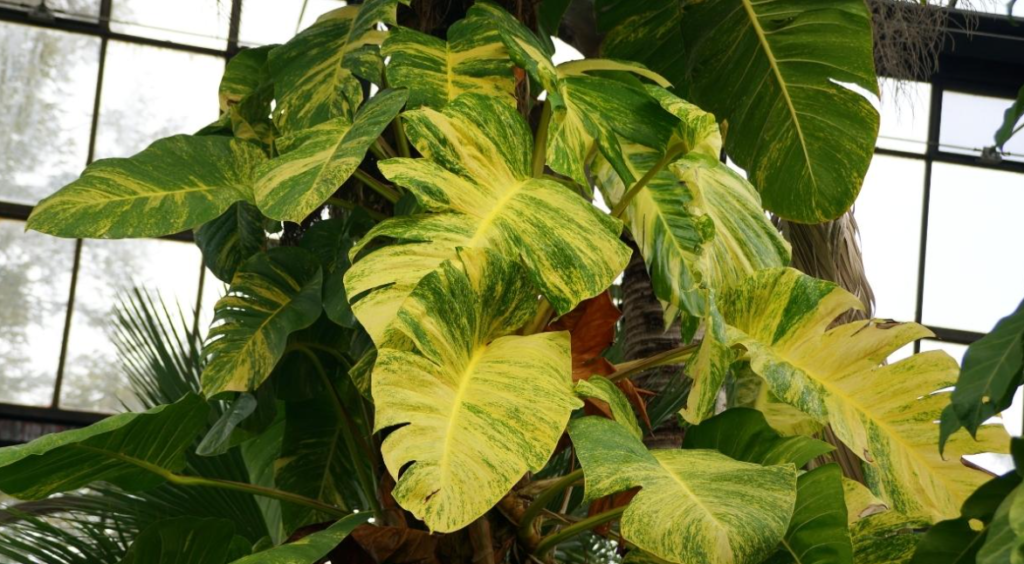
Care
Because of their similar growth habits and color, these plants are very similar in care. They are both beginner-friendly and low-maintenance, making them ideal plants for first-time growers to tackle.
the light
Devil ivy plants grow in bright indirect light
Bright indirect light is best for all pothos plants, to mimic natural growing conditions.
Pothos plants can handle a wide range of light conditions with ease. They appear on many low-light tolerant houseplant lists and will show no signs of struggle in almost any corner of your home with at least one window.
But, if you want them to grow to their full potential, bright indirect light is the goal. It closely mimics the sunlight conditions they are accustomed to in their natural habitats, climbing trees or on the forest floor.
Hawaiian pothos in particular will benefit from bright indirect light to improve leaf growth. This cultivar is sought after for its spectacular foliage, so it must be given plenty of light to grow to its full potential. In low light conditions, the leaves may not reach full size and look like golden pothos.
Neither variety can handle long periods of direct sunlight. Some direct light morning sun is usually fine and can actually promote growth in the right weather. Any strong afternoon or afternoon sun will have the opposite effect, burning the leaves and affecting growth.
The space in front of an east-facing window or a south-facing window is intended to be filtered with a curtain to limit direct sunlight exposure.
How to Propagate Hawaiian Pothos
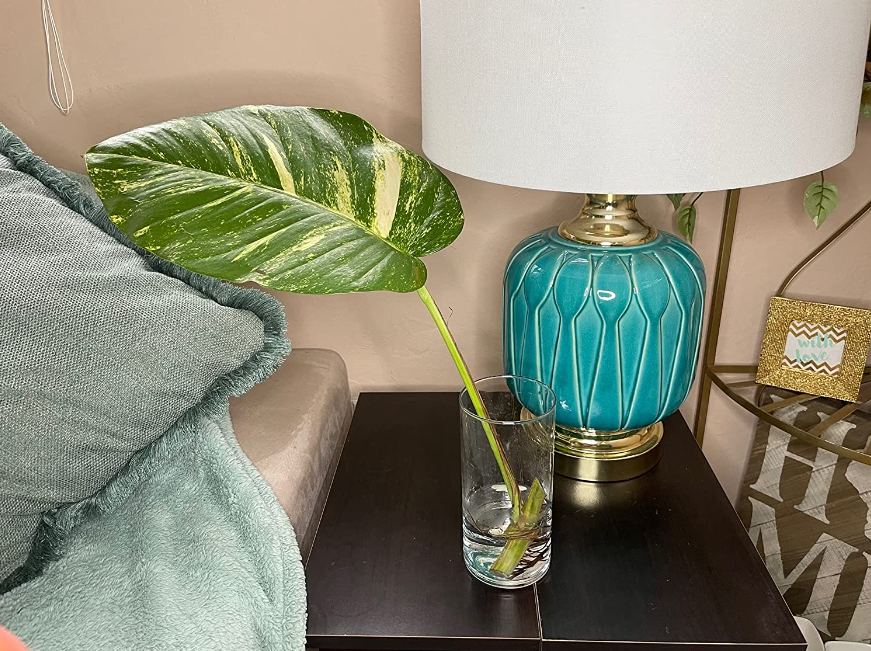
To grow aerial pothos using cuttings, you need a piece of plant that is 6 to 8 inches tall with 5 or 6 leaves on it. Remove all the leaves but the top two and put the stems in a glass of water several inches deep.
Because aerial pothos can be difficult to find, learning how to propagate your plants can be a valuable skill. Propagating these plants is very easy. You can grow them from cuttings or use air layering to create new plants.
If you choose to propagate it in water, according to the method described above, the stem should grow some roots after six to eight weeks. At this point, you should place the stem in a pot of filled soil and water it well. After another two months, it will be a healthy, self-sustaining plant.
To practice air layering to create a new plant, you will need some sphagnum peat moss. On a healthy vine, peel off the outermost layer of the plant with a sharp knife to expose the plant’s inner cambium layer. Make a small bundle by wrapping peat moss around the stem, covering it with plastic wrap, and in a few months, new roots will appear, at which point you can cut the new plant and pot it up.
Water
Normal plants with humidity
It is best to let the top 1-2 inches of soil dry before watering your pothos plants.
Nor is Pothos particularly thirsty. The topsoil should be allowed to dry completely before watering again. It is better to test the soil with your finger or a skewer before watering than to water on a schedule to prevent waterlogging and root rot.
Because the Hawaiian Pothos is larger, it will need to be watered more frequently than the Golden Pothos. However, this difference is almost unnoticeable in most homes and shouldn’t affect development much. External conditions such as temperature and light levels have a large effect on a plant’s water needs.
When submerged, the leaves will indicate that they need to drink by wilting or bending inward. Because of their thickness, it may take some time for them to show signs of struggle. If you often water late, invest in a moisture meter that will tell you the best time to water your plants without them drying out too long.
What Kind of Fertilizer Do I Need for My Hawaiian Pothos?
A water-soluble fertilizer is best for pothos plants. However, mixing it at half the recommended strength will help you avoid “burning” your Hawaiian Pothos with too much fertilizer. You should add this water-soluble fertilizer to the pothos plant instead of regular watering once every month.
A water-soluble fertilizer for your aerial pothos plant should be a balanced fertilizer, such as 15-15-15 or 20-20-20. During the winter months, you can hold off on fertilizing until spring.
soil
Devil’s ivy cuttings growing in soil.
Well-drained soil is essential to prevent root rot or other fungal diseases.
Plants grown in containers are more prone to root rot. Because they are in an environment where water can sit around and stagnate, you need to make sure that as much water as possible is drained away from the soil while retaining enough to irrigate the roots. Root rot and eventual death of the plant should be prevented.
Both plants thrive in well-drained soil. The containers they are planted in should also have plenty of drainage holes, otherwise, the consistency of the soil will not be as effective.
Look for special houseplant soil at your local nursery or online. You can also make your own by mixing two parts potting soil with one part perlite and one part coconut coir.
Perlite improves drainage by increasing the space between soil particles. Coconut coir improves moisture retention without oversaturating the roots. It can also be replaced with peat moss if you already have some.
What are some common problems for Hawaiian Pothos plants?
Much of the attraction of Hawaiian Pothos is the green and yellow coloring on the leaves. If your Hawaiian Pothos plant starts to lose its variegated shape, it’s a sign that it’s getting too much sunlight. Move your Hawaiian Pothos to a more secure location and it will begin to correct the problem in no time.
You may find pests on your plants, such as aphids, spider mites, or mealybugs. You can find insecticidal sprays at your local garden center to kill these pests. Or you can spray the plant with soapy water that can kill the bugs.
If you find fungus on your pothos plant, it could be a sign that you are overwatering it. Allowing the pothos to dry completely can help kill the fungus. However, an antifungal spray from your garden center can help kill the fungus while you are trying to dry out the plant.
Propagation of Hawaiian Pothos
The best way to propagate aerial pothos is by stem cuttings. They root very quickly and grow well. Take a cutting with at least one node and two leaves and put it in water for 4 to 6 weeks when it starts to root, then you can put it in the soil. Keep it moist and in indirect sunlight and you’ll increase its chances of success. Hawaiian pothos cuttings grow quickly and root quickly, so your success rate should be high.
Hawaiian Pothos vs Golden Pothos – The Difference
In general, Hawaiian pothos and golden pothos are quite different from each other. Golden pothos has a bright color while Hawaiian pothos has a variegated pattern of dark green, yellow and white.
Let’s take a look at some of the differences between Hawaiian Pothos and Golden Pothos.
Golden pothos prefers low light while Hawaiian pothos prefer high or medium light.
Golden pothos usually has yellow vines while Hawaiian pothos produces green stems when conditions are right.
The main difference between golden pothos and Hawaiian pothos is their color.
While golden pothos has dark green, white or yellow streaks, they are bright yellow.
Hawaiian pothos has variegated colors along the lines.
The color of Hawaiian pothos remains the same in all seasons.
While the color of golden pothos changes with the change of season.
Similarities
Although there may be some differences, these two plants have a lot in common.
There are only a few notable similarities that can make these plants very difficult to tell apart.
genealogy (ranking)
If you’re wondering why these plants are so similar, here’s why – both are cultivars of Epipremnum aureum.
The parent plant is sometimes called the mini plant or devil’s ivy, but it is also known as the golden pothos.
This latter nickname has caused confusion, as the true scientific name of the Golden Pothos cultivar is Epipremnum aureum ‘Golden’.
Meanwhile, Hawaiian pothos is known botanically as Epipremnum aureum ‘Hawaiian’.
It is common to nickname the plant using the cultivar name followed by the most common species name, hence “golden pothos” and “Hawaiian pothos”.
When searching for a specific plant online, keep this in mind, as it is quite common for different plants to share common names.
No catfish.
Epipremnum Aureum is often confused with the similar-looking Philodendron species, but there is one key difference: the cataphyll.
This special sheath protects the new leaves until they are ready to sprout.
This feature is not present in Pothos plants, where the leaves bloom and develop without any special protection.
size
Sometimes cultivars can vary significantly in size, but not both.
In captivity, both cultivars will reach a maximum height of 10′ feet but can grow to about 30′ feet if left in the wild.
The leaves are similar, although Hawaiian pothos is slightly larger and grow a little faster.
Growth habit
These plants have a trailing habit but can easily be trained to grow moss poles or trellises.
Is golden pothos rare?
Pothos Golden pothos is a popular plant and although they are not hard to find they are in high demand.
This plant is also extremely easy to care for and that is why many people want to keep this type of plant which is a bit hard to find.
Golden pothos is also extremely easy to propagate and if you let the vines grow, you will have lots of golden pothos from just one plant.
Yellow leaves of Hawaiian Pothos
Yellow leaves are caused by overwatering your pothos. They can also be underwater in some cases. Check the soil and you’ll know which one it is, and in either case, check the soil every week and water only when it’s dry. This way you will avoid going overboard and under water. You can cut off the leaves that are turning yellow. It’s also a good idea to plant healthy parts of the plant at this point if root rot is fatal.
Is Hawaiian Pothos the same as Golden Pothos?
Are Hawaiian Pothos and Golden Pothos the same? They are indeed similar plants, and sometimes confused, but they are different. Hawaiian Pothos has a stronger yellow color in its diverse regions.
Maintenance requirements
With these two cultivars so closely related, it should come as no surprise that their care requirements are nearly identical.
This includes not only their preferences for temperature, water, and soil. But also methods of preaching.
Golden pothos gets fenestration.
You may be wondering what is fenestration. Plants such as golden pothos and monstera, which are native to dense tropical forests, have leaves that allow sunlight to reach the lower leaves.
As you can see in the photo above, my golden pothos is now being stained. Their leaves split at maturity in their native habitat, allowing rain and sunlight to reach the roots as they form vines in the wild.
What is unique about Hawaiian pothos?
Hawaiian pothos plants are native to French Polynesia and have the lush appearance you would expect from a tropical jungle plant.
Its large, glossy leaves are covered in brilliant streaks of brilliant green and gold, creating a vibrant image wherever it is placed.
Its vining habit allows it to either be trailed from a hanging basket or trained to receive support for vertical accent.
At the same time, the Hawaiian Pothos plant is easy to grow with minimal maintenance. This makes it ideal for someone who doesn’t have the skills or time for a demanding plant.
How Big Are Hawaiian Pothos?
Hawaiian pothos plants are one of the largest types of pothos plants. This popular, easy-to-grow plant typically grows to about 1 to 2 feet in diameter. Hawaiian pothos plant vines can grow up to 4 feet in length, but if the vines get too long, you can trim them back to a more manageable size.
Golden pothos gets fenestration.
You may be wondering what is fenestration. Plants such as golden pothos and monstera, which are native to dense tropical forests, have leaves that allow sunlight to reach the lower leaves.
As you can see in the photo above, my golden pothos is now being stained. Their leaves split at maturity in their native habitat, allowing rain and sunlight to reach the roots as they form vines in the wild.
This may not happen often with your golden pothos, but if conditions are favorable, you may get lucky. Hawaiian pothos will not have these types of fenestrations.
Hawaiian Pothos FAQs and common problems
Variegation can die out in low-light areas, they can also get leggy if not given enough light. As mentioned earlier, you can move around in bright areas with plants. You can also cut leggy parts of the plant and spread them out and plant them with the main plant to make it whole again.
Other Articles You May Like
You may also like these articles: Cebu Blue Pothos, Philodendron Vs Pothos, Satin Pothos Care.
Please follow us on Instagram and Pinterest for regular plant updates and occasional plant giveaways.
How Big Are Hawaiian Pothos?
Hawaiian pothos can be hard to find, but that still makes it a favorite plant for every home.
This house plant can grow from 0.3 to 1.2 meters which is about 1-4 feet and the space it takes is about 0.3-0.6 meters which are about 1-2 feet.
How does Big Do Golden Pothos grow?
Golden pothos can reach 20 to 40 feet tall and 3-6 feet wide when fully mature. This type of pothos grows well in partial shade and prefers acidic to neutral soil.
Which type of pothos grows the fastest?
There are many types of pothos. Let’s take a look at some pothos and let’s find out which pothos grow the fastest!
Marble Queen: It has heavily colored leaves with cream, dark green, and light green spots.
Snow Queen: This type of pothos is similar to Marble Queen but is more white than green in color.
Neon: This plant is known for its chartreuse color and has no pigment.
Pearl and Jade: This plant has dots of color instead of white and green stripes and can grow tall if given the right living conditions.
Silver Satin: This plant is very tolerant of all types of weather and has thick green-gray leaves with a touch of silver.
Temperature and humidity
Pothos plants grow in hot humid climates
Warm, humid climates similar to tropical climates are ideal for growing pothos plants.
Coming from the same tropical forest conditions, both plants require the same temperature and humidity.
Like most houseplants, pothos needs a warm indoor temperature between 65F and 85F for their best growth. They handle heat better than other houseplants but do not tolerate cold. Never allow temperatures to drop below 50F and keep plants away from windows in winter to prevent cell damage.
When it comes to humidity, the higher the better. Humidity in tropical rainforests ranges from 70% in the dry season to 90% in the rainy season. Then it goes without saying that these plants appreciate as much moisture in the air as they can get.
Keep any plant in a room with at least 40% and higher humidity. The preferred number for us to find a happy medium between indoor and outdoor preferences is 60%.
How Big Are Hawaiian Pothos Leaves?
Unlike many other types of pothos plants, Hawaiian pothos leaves can be very large. When the plant is healthy, the beautiful yellow and green leaves can grow up to 12 inches in length. Small leaves on Hawaiian pothos plants will be about 5 inches long.
Golden Pothos
Hawaiian pothos and golden pothos are almost identical except for their different colors. The leaves of golden pothos have dark green, yellow and white stripes, but are mostly bright yellow.
Hawaiian pothos
Its color varies with dark green, yellow and white stripes.
It does not go through the same autumn color change as all other plants. The color remains the same, but the intensity of the green varies depending on how much sunlight the plant receives.
How long does golden pothos take to grow?
Golden pothos can grow about 12 inches per month during the growing season. This growth rate is usually under average conditions that are common in our homes.
If you want to grow golden pothos with cuttings, it may take longer to grow and will reach its peak by 4 or 5 months of age.
How long does Hawaiian Pothos take to grow?
Hawaiian pothos may take a little longer to grow than golden pothos.
If you put the cuttings in potting mix, and keep the soil moist and out of direct sunlight, you should see roots develop within a month and your plant will be ready in two to three after that. It will take months!
Do Hawaiian Pothos Grow Fast?
Hawaiian pothos plants grow reasonably quickly, but some of their growth rate depends on how well you care for your plant. A well-maintained plant with ideal growing conditions will grow quite quickly. These are great plants for the impatient gardener because you can see an immediate return on all your efforts.
Potting and repotting
Hawaiian Pothos repotting only needs to be done every year or so. You’ll know it is when roots start coming out of the drainage holes at the bottom. Early spring is best before it exits its dormant stage.
When repotting giant air pothos, don’t oversize the pot: only go up 2 inches in diameter.
The most important thing to look for when potting is to have a pot with drainage holes to allow water to drain out.
Fill the new pot with fresh potting soil, leaving room for the root ball. Apply it as before and water well, letting excess water drain out.
Sheath
Plants like philodendrons have this cataphyl—a waxy, thin, and opaque sheath—that covers new leaves. Pothos leaves, on the other hand, lack sheaths.
New pothos leaves grow on their own, turning a lighter green color from the existing leaves.
Growth habit
All kinds of pothos are gliding along with previous habits. Typically, it can grow 6 to 10 feet. But pothos in their native habitat can grow 30 to 50 feet.
You will see giant pothos from the forest, where they can walk on the high trunks of trees.
Common problems you may encounter with your Pothos.
A common problem you may encounter with your pothos is insects. The most common pests are mites, mealy bugs, and aphids.
There are also some less common pests called scale and thrips. However, it is important to know that you need to take special care of your plants and if there is an attack by insects, your plant may die if not taken care of properly.
So if you see any signs of pests, spray the area with water and if they come back, use neem oil or horticultural oil to get rid of them.
Another problem you may encounter with your pothos is a disease. If your pothos has a disease, you may notice some brown or yellow spots on the leaves.
If you want the plant to get rid of any disease, try to keep your pothos in a ventilated place
Do you grow Hawaiian pothos indoors?
While the Hawaiian Pothos plant grows wild outdoors in tropical locations, it grows very well indoors as a houseplant. These plants are great as houseplants because they can help filter indoor air and remove impurities. Also, their variety is great for home decoration purposes.
Additionally, humans have evolved to crave greenery and Hawaiian pothos can improve mental health when grown indoors.
Height and structure
The order of Pothos leaves is alternate. You will notice that each node has only one leaf, while it grows in an ascending spiral.
Pothos has a simple variety of leaves with blade lengths of 4 to 8 inches, 8 to 12 inches, 12-18 inches, and 18-36 inches.
When it comes to the height of a Pothos, it depends on its support structure. The longer the structure, the longer it goes upwards.
Pothos, on the other hand, continue to spread as long as there is land where the leaves can grow.
It grows quickly, so the right height structure based on your preferences is very important.
Common problems
Devil’s ivy leaf with brown spots and a yellow leaf.
Brown sunspots and yellow leaves are two common problems with pothos plants.
Considering their close relationship in growth and maintenance, it is not surprising that these plants face the same problems. Watch for these problems and adjust your care accordingly to correct them:
Yellow leaves: Usually a sign of overwatering, which is present in the green parts of older leaves. Be careful not to confuse abnormal yellow discoloration with normal discoloration.
Wilting: Usually a sign of waterlogging but can also be caused by overwatering. Assess the soil and amend as needed.
Brown or black tips: due to waterlogging or low humidity. A combined humidity and temperature meter will help you better predict which is more likely.
Brown patches: Result of direct sunlight exposure. Move the plants to a location with indirect light and cut off any heavily damaged leaves.
Propagating Golden Pothos vs. Hawaiian Pothos
Pothos – regardless of their variety – are easy to propagate. You can grow it by cuttings, and give it to your family and friends.
If not, you can keep your Pothos sectional in your home to enjoy their lush and laid-back look.
What’s more, you can spread them in either soil or water. To start, find a healthy vine that is 4-6 inches tall and has three leaves, then cut a stem above the root node.
If you want to spread it in water, prepare a water bottle and add water to it. Place the cutting and allow the cut ends to sink.
Now, if you want to do it in soil, place the cuttings in a small pot with soil.
Growing needs
When talking about the care points required for Golden Pothos and Hawaiian Pothos, you don’t need to second guess because they are under the Epipremnum aureum family.
Perhaps the only difference is that Hawaii needs to preserve its color which makes it different from other types of pothos.
harvest
Giving your Hawaiian pothos an occasional trim can help keep it looking its best.
Remove any dead or damaged leaves at any time. Fresh new growth will be encouraged if you cut the stem just above a leaf node.
Giant Hawaiian Pothos can also be pruned to form a plant. You can cut a third of the plant at a time, usually in early spring or fall.
Do not attempt to prune Hawaiian pothos while it is actively growing.
Use sharp scissors or a knife to make clean cuts.
You want to train your aerial pothos on a sphagnum pole at the same time you prune.
Temperature: Golden Pothos and Hawaiian Pothos have similar temperature requirements. The ideal temperature for growing pothos is between 65°F and 85°F (18°C – 29°C).
Light: As you base your Pothos culture, they thrive best in shade where it gets plenty of light.
However, when it comes to aerial pothos, you need to keep them in medium and high light to maintain their variety. Keep it out of direct sunlight to protect its foliage.
Soil Requirement: According to research by Edward F. Gilman of the University of Florida, pothos soil tolerance is slightly alkaline, clay, sand, acidic, occasionally wet, and loam.
Uses of plants
Devil’s ivy plants are commonly used as ornamental plants.
Both plants are considered common houseplants.
Golden Pothos is the ultimate indoor plant in interior design, on shelves, on the corner of your desk, or with ease on your windowsill. Their golden flakes are the perfect complement to a sunny day and brighten up any room.
Because of their large size, Hawaiian pothos needs a little more space. When trained around moss poles in a large pot, they make large upright plants to fill in the corners. Their large leaves are wonderful air purifiers and add a tropical feel to any space.
Can Hawaiian Pothos Live Outside?
In tropical climates, Hawaiian pothos grows well outdoors if they have enough cover from harsh sunlight. In any climate, you can keep your Hawaiian pothos outdoors if you have deep shade on a covered porch. However, once the temperatures start to cool in the fall, you’ll need to bring it inside.
Hawaiian pothos plants are not cold or hardy at all, so if you keep your pothos outside for the summer, you should pay attention to the weather forecast as fall approaches. Once the temperature starts to drop below 60 degrees, you must bring the plant inside or it will die.
If you keep your Hawaiian Pothos outside during the warmer months, make sure you choose a very sheltered spot. If the plant gets too much sun, your pothos can get sunburned leaves. A shaded porch is a perfect place outside for your Hawaiian pothos.
Soil Requirement: According to research by Edward F. Gilman of the University of Florida, pothos soil tolerance is slightly alkaline, clay, sand, acidic, occasionally wet, and loam.
Pothos care is popular with beginners because it grows in a variety of soils.
However, keep in mind that this study refers to the type of soil where it can grow, not where it can try.
Pothos plants hate sitting in wet soil. So you need to make sure that the soil has good drainage.
If your local areas soil has a clay texture, you can add more perlite, coco coir and sand to improve the plant’s drainage.
preaching
Propagation of Hawaiian pothos is easy and a great way to create more plants for yourself or others.
The easiest way to propagate giant air pothos is by rooting stem cuttings.
Choose 4-6 inch stems with at least 2 or 3 leaves, and cut them just below a leaf node. Remove all but 2 leaves at the tip of the stem, and place the cuttings in a pot of water.
Place it in a bright spot out of direct sunlight and change the water every few days.
It will only take a month or so before the roots are about an inch long and you have new little plants ready to grow.
Are Hawaiian pothos rare?
Hawaiian pothos is often one of the more difficult pothos plants to find at your local garden center. They are less common than other types of pothos, so they are considered rare. If you do manage to get one of these plants, you should take good care of it because it can be difficult to replace.
- Insects
- Hawaiian Pothos bugs are not very common, but occasionally you may experience some insect infestations.
- Common pests on giant Hawaiian pothos are common houseplant culprits: mealybugs and scales, and less commonly, aphids and spider mites.
- Mealybugs can be identified by the presence of cutworms on the underside of leaves.
- Scales appear as small brown spots on the stems and leaves.
- Spider mites leave small white or yellow spots on the upper side of the leaves.
- Aphids are light green in color and suck sap from leaves and stems.
- Use non-toxic sprays such as insecticidal soap, neem oil, or pyrethrum to control infestations.
- Hawaiian Pothos vs. Golden Pothos
The main difference between Hawaiian pothos and golden pothos is that golden pothos plants have pale yellow leaves with some green while Hawaiian pothos plants have pale yellow and green leaves. Hawaiian pothos also has larger leaves than golden pothos.
You can sometimes see yellow vines on golden pothos when they have enough light, while Hawaiian pothos vines will always be green when they are healthy. Golden pothos leaves can also develop scabs – or holes in the leaves – while Hawaiian pothos will not.
That said, you won’t be accused of confusing the two though (like how easy it is to confuse a Snow Queen vs. As are However, they are different plants, and if you look carefully you should be able to tell them apart.
Last words
Differentiating between two types of plants in the same family can be both interesting and confusing.
Nevertheless, knowing the different types of plants, including their growing needs, can be helpful. Here are three main points to summarize everything in this article:
Hawaiian Pothos is a variety of Golden Pothos due to selective breeding. Its appearance is characterized by yellowish spots. The stem color is also yellow, while the leaves become larger with time.
Although both types of pothos have similar growing needs, Hawaiian pothos needs medium or high light. That is, to maintain the intense yellow color of the plant without compromising or drying it out.
The method of propagation of Hawaiian and Golden Pothos is the same. By cutting, you can multiply the number of pothos plants you have at home. You can propagate them either through soil or water.
Growing problems
You may experience some growing problems with your aerial pothos, but you usually need to adapt to the growing conditions to cure your diseased plant.
If the leaves of your Hawaiian Pothos are losing their characteristic yellow color, they are probably getting too much sunlight. Take it out of the direct sun and it should bounce back.
If the leaves are falling, check the soil. If it is too wet, cut back on watering. If it is too dry, water more often.
If the edges of the leaves are turning brown and shriveled, you should find a warm spot away from cold drafts.
Toxicity of Hawaiian Pothos
Giant Hawaiian pothos is toxic to both humans and animals due to the calcium oxalate present in all plant parts.
Its toxicity is quite low, meaning that one would have to ingest large amounts for a fatal dose, but even small amounts can be quite serious, especially to small creatures such as pets or small children. of the. For humans
Hawaiian Pothos is definitely poisonous to humans.
Adults are unlikely to try to eat it, but children can sometimes try to ingest some of it, causing swelling of the lips, tongue, and mouth and vomiting.
In such a case, take the child to the emergency room for medical attention.
To prevent exposure to children, keep plants out of reach of small children.
Adults are more likely to develop skin allergies from working with plants. Wash the skin thoroughly with soap and water, and use an antihistamine cream to relieve any itching or irritation.
The appearance of Hawaiian Pothos
The appearance of Hawaiian pothos is lush and tropical. Its large, shiny leaves have a striking combination of bright green and gold, creating a vibrant look.
Although it is related to the golden pothos, its leaves are much larger and the color variation is more dramatic.
Plus, its sprawling growth habit will quickly become an imposing component of your indoor garden or outdoor tropical oasis.
Final thoughts
Golden Pothos Hawaiian Pothos vs. Golden Pothos are very similar to each other. At a glance, you won’t even notice the difference but they are still very different!
Although these two plants require similar care, they still have different needs and there is no way you can keep both plants happy!
Both of this pothos are extremely easy to care for and make a great houseplant! So if you’re just starting out in gardening, this might be the plant you’re looking for!
Before you go, here are some other related articles I encourage you to read below to help solve your gardening problems
Fertilizer
Healthy leaves of Pothos plants are closed.
Pothos plants appreciate a balanced fertilizer throughout the growing season.
Pothos are not heavy feeders but benefit from fertilizing in the spring and summer when they can last for a year or two in the same pot without topsoil.
You can fertilize both crops with the same balanced liquid fertilizer once every 4-6 weeks during the active growing season, fall and winter. Slow-release fertilizers are also suitable for these plants, usually available in sticks that are buried in the soil to break down over time.
Conclusion
You can’t go wrong with golden pothos or Hawaiian pothos. Both plants are quite hardy and can stand up well to a little neglect. This means that either variety can be an excellent plant for novice houseplant owners. Because they look so similar, barring slight differences in leaf size, they make wonderful partners and make great additions to any houseplant collection.